
乔家大院
Israel in Need of Political Reform to Make Stable Government Possible, Experts Say_我的网站

A |
一键部署OpenClaw 今天,千问办公悄然开启内测。 Last week, Israel's parliament voted to dissolve itself after the ruling Bloc of Change coalition had lost its paper-thin majority. Lapid, who served as the foreign minister in Bennett's cabinet and is also the leader of the largest opposition party Yesh Atid, assumed the office of prime minister until the next parliamentary elections scheduled for November. This will be the country's fifth snap vote in under four years.,The previous one took place in March 2021 after the parliament had dissolved itself due to the failure to adopt a state budget by the deadline. It ended with Lapid forming a coalition agreement with Bennett, who leads the right-wing Yamina political alliance, entailing a rotational two-year premiership.,Unique Coalition,The coalition created by Bennett and Lapid was the most diverse in Israel's history, consisting of parties that run the gamut from right to left, religious to secular, and even included an Arab party, the United Arab List (also known as Ra'am). Other coalition members included Yesh Atid, Yamina, Blue and White, Yisrael Beiteinu, New Hope, Labor and Meretz.,The coalition's diversity is explained by the shared desire to prevent Benjamin Netanyahu, the leader of the right-wing Likud party and a former prime minister, from once again taking power. However, the variety of political forces presented in the coalition also made it hard to sustain.,"The effort and the energy that were invested in maintaining the coalition government throughout this year actually exhausted the government and the people at the top, and they couldn’t really deal with certain issues that could have given them credit were they successful in surviving until the next elections," Tamar Hermann, a professor of political science at the Open University of Israel and academic director of the Viterbi Family Center for Public Opinion and Policy Research at the Israel Democracy Institute, said.,According to Itzhak Galnoor, a senior research fellow at the Van Leer Jerusalem Institute and emeritus Herbert Samuel professor of political science at the Hebrew University of Jerusalem, the Bennett-Lapid government should have invested much more effort in keeping the alliance together, which they failed to do.,"It was an attempt to save Israeli democracy, prevent corruption, show that a government can function without all those tricks and things that the Netanyahu government was notable for doing for many years. In this way, I mean the second part, they actually did succeed for a while. So, the main failure, as I said, was the problem of maintaining some politicians within the parties who knew exactly what they were getting into. It wasn’t just that the whole experiment was a failure, it was more of a personal thing," Galnoor said.,The expert also suggested that if the Arab political alliance Joint List, which was not part of the ruling coalition, had given its support to the government and overcome the personal animosity between them and the United Arab List then the coalition would have survived.,"So, it is difficult to say more than we have now personification of politics, which makes it very difficult to have a coalition and it does not matter even if we may have ten elections," Galnoor surmised.,Meanwhile, Liron Lavi, a lecturer and research fellow at the UCLA Y&S Nazarian Center for Israel Studies, drew attention to the changes in the Israeli political spectrum.,"'Right' and 'Left' are much less about the Israeli-Palestinian conflict- the main issue that has defined Israeli politics since 1967. Instead, the political axis in Israel is being re-shaped around issues of the state's Jewish identity and democracy," she stated, adding that "in light of this change, and until the political axis will be redefined and parties will realign themselves along it, we are expected to see more political instability in Israel in the near future.",Time for Change,The series of snap elections has revealed the issues with Israel's current electoral system, in which parliamentary seats are proportionally divided between parties and a ruling coalition must secure 61 seats in order to form a government. However, creation of a stable political coalition out of sprawling factions has become a daunting task. At the same time, parties are currently the least trusted political organizations in Israel, with people often having little idea what is the real difference between them, according to Hermann.,"Many parties do not even have platforms, so people vote by identification based on, as I said, the level of religiosity and past experience," Hermann explained. "The parties are, in a way, obsolete, but we don’t have any alternative channel for choosing the candidates for the national elections, so if the electoral system is changed, probably the parties will have to adapt and maybe become more relevant.",Galnoor, for his part, underscored the need to make sure the country has a stable government and ruling coalition, noting that the Israeli Democracy Institute suggested the following changes to the country's parliamentary system: making the head of the biggest party after the election the prime minister by default so they could form a governing coalition as well as introducing mixed elections, with some lawmakers representing geographic constituencies instead of being voted on via party lists.,"You have, let’s say, a member of the Knesset [who] represents the Negev, the south, he would have to represent all the people in the south. It would be Jewish and Arab and it would be Orthodox and non-Orthodox, so you would have a representative, a member of the Knesset, that cuts across the differences in society," the expert outlined the idea.,Shmuel Sandler, the professor emeritus of political science at Bar-Ilan University and a senior research fellow at the Begin-Sadat Center for Strategic Studies also called for electoral reform and hoped that a coalition without Netanyahu might implement it.,"He would try to go for a reform in which the head of the largest party is also elected as PM. But this does not assure stability," Sandler noted.。没有发布会,没有媒体通稿,但这个产品的低调上线,可能是 2026 年国内 AI 应用领域最值得关注的信号之一。
 阿里 Agent 线的“三合一” 千问办公并非从零起步。此前阿里内部并行着三条 Agent 产品线——QoderWork、悟空、MuleRun,如今全部收拢整合为“千问办公”一个产品,由钉钉新任 CEO 陈宇森牵头主导。 三线合一的信号很明确:阿里对办公 Agent 赛道的判断不是试水,而是决战。 第三代办公产品的范式迁移 理解千问办公的分量,需要回到办公产品的演进逻辑。

B | 第一代 Office,本地装软件,活自己干。第二代云协同,以钉钉为代表,多人一起干,但活还是你的。

C | 前两代商业逻辑一致——做好固定产品,所有人用同一套东西,靠规模效应盈利。 第三代完全不同。以前卖的是固定产品,现在卖的是一种智能。这种智能帮你造最适合自己场景的工具,天然为你定做,不存在功能用不上,也不存在缺了你想要的。 这个逻辑的颠覆性在于:国内 SaaS 市场一直被诟病“碎得一塌糊涂”,需求长尾、不标准、无法规模化。

D | 过去这是行业痛点,现在反倒成了通用 Agent 的机会——一个能自己造工具的东西,最擅长处理的就是长尾和不标准。

E | 四要素齐全,为什么是阿里 Work Agent 最终拼的是四件事:模型决定智力,业务广度决定能力,企业数据决定它可否可用,组织身份和权限决定安全下限。

F | 阿里恰好是国内少数能同时凑齐这些要素的公司。上有 Qwen 模型,中有阿里云、百炼等基础设施,下有钉钉沉淀多年的组织关系、消息、文档、流程和权限。

G | 别人需要从零拼接的东西,阿里天然就长在一起。这也是陈宇森来牵头的原因——钉钉的组织关系和数据沉淀,是千问办公区别于纯模型产品的核心壁垒。 目前客户端和钉钉版本已上线,未来还有网页版,三端一致。钉钉侧栏可直接处理群聊、日程、待办和各种企业工作。还有一个值得关注的细节:千问办公可以生成 HTML,连域名、数据库和托管都一并做好,一站式打通了从生成到部署的最后一公里。  典铭云赛五周年庆,团队 140 多企业数字化专家合影 真正的门槛在“用起来” 千问办公的产品力毋庸置疑,但行业经验反复证明同一件事:强工具到手,不等于企业能用起来。 某制造业 CIO 告诉记者,去年团队满怀期待采购了一套 AI 协作工具,三个月后后台活跃率不到 10%。

H | “工具确实强,但没人知道怎么跟自己的业务结合,没人教怎么改 Agent 的指令,没人能回答我这个行业到底能用它做什么。” 这不是个例。AI 工具的落地,从来不是买完就完事。模型再强,Agent 再智能,如果没有人帮企业把业务需求翻译成 Agent 语言,没有人帮团队建立使用习惯,那它就只是一个昂贵的摆设。 这个 gap,正在催生一个新的服务市场。  典铭云赛前沿部署工程师团队(FDE)在客户现场深度陪跑 FDE 模式:把工程师派到业务现场 在千问办公的生态中,一批服务商正在承接“最后一公里”的落地工作。其中,典铭云赛作为阿里云旗舰级头部伙伴、钉钉六星级钻石头部服务商,提供的是一种名为 FDE(Forward Deployed Engineer,前沿部署工程师)的服务模式。 FDE 不是传统售后支持。

I | 它的核心区别在于:工程师不是在远程等工单,而是直接深入企业业务现场,跟团队一起工作、一起发现和解决问题。典铭云赛将这一模式拆解为六个环节——需求调研、方案定制、Agent 定制开发、全员培训、交付落地、全程陪跑,覆盖从第一天到最后一天的全生命周期。 值得注意的是,FDE 模式并非典铭云赛首创。硅谷大数据公司 Palantir 正是靠前沿部署工程师模式拿下了政府和企业大客户。其核心逻辑是:通用产品解决 80%的问题,剩下 20%的定制化需求,靠驻场工程师跟客户一起解决。而在国内 AI 办公市场,这种模式正在被快速验证。
 图为:典铭云赛前沿部署工程师团队(FDE)在客户现场调研 落地样本:四家制造企业的 AI 实践 记者了解到,典铭云赛的 FDE 服务已在多家制造业企业落地。虽然各家场景不同,但共同特征是:每一家都不是靠标准产品解决的,而是靠 FDE 团队深入业务现场、反复打磨出来的。 某通用动力机械头部企业——产品线覆盖发电机、水泵、清洗机等品类,业务链条长、SKU 复杂。典铭云赛团队深入其生产、供应链和销售环节,通过定制化 Agent 打通了从订单到交付的关键数据链路,让业务人员能用自然语言直接查询和分析数据,大幅降低跨系统协作的沟通成本。
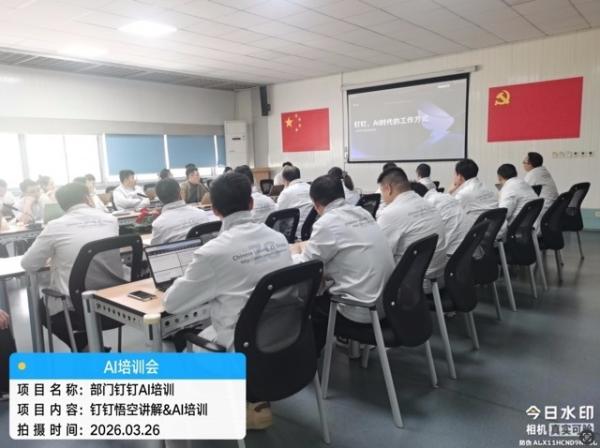 图为:典铭云赛前沿部署工程师团队(FDE)在给客户做 AI 工具的使用培训 某医药制造企业——医药行业对合规和追溯要求极严。典铭云赛为其定制了贴合 GMP 规范的业务流程 Agent,将质量审批、文档管理和生产记录搬上智能协作平台。FDE 工程师长期驻场跟线,深入车间和实验室理解真实场景,确保系统不是“合规摆设”,而是被一线人员日常使用的工作平台。 某通用机械制造龙头——年营收过百亿,组织架构复杂、数据分散在多个异构系统中。典铭云赛从需求调研入手,在一线跟不同部门对话,梳理出十几条高优先级 AI 可发力场景,然后分批次交付落地,每一步都跟业务团队一起验证效果、调整方向。 某摩托车制造企业——面对终端市场竞争加剧,典铭云赛帮助其搭建了从市场洞察到产品反馈的数据分析 Agent,让营销和产品团队能实时获取终端动态和竞品动向。同时通过全员培训,让销售、市场、产品三大部门核心人员都能独立使用,实现从“靠经验决策”到“靠数据决策”的升级。 一位接近上述某制造企业数字化项目的人士评价:“工具是通的,方法论是通的,但落地的最后一公里,必须有人在现场。”
 典铭云赛前沿部署工程师团队(FDE)为神驰机电数智先锋训练营提供全程陪跑服务,图为训练营结营仪式。

J | 服务商正在成为 AI 落地的关键变量 千问办公的上线,标志着一个认知转折的开始:每个人打开电脑的第一个念头,会慢慢从“我要用什么工具”变成“我要让谁帮我干这件事”。 这个趋势不可逆。但趋势的红利,只属于真正行动并行动对的人。

K |

L | ">典铭云赛前沿部署工程师团队(FDE)为希尔安药业 AI 创新大赛提供全程陪跑服务,图为大赛总决赛现场。 当产品能力趋于同质化,真正拉开企业AI落地差距的,不再是工具本身,而是有没有人帮你把工具用起来、用对、用深。典铭云赛这类服务商的存在,恰好填上了这个缺口——既懂千问办公的产品内核,又懂企业真实的业务痛点,用FDE模式把两者焊接在一起。 对于正在评估千问办公的企业来说,选产品只是第一步。选谁来陪你落地,可能才是决定成败的关键。

M |
申请创业报道,分享创业好点子。点击此处,共同探讨创业新机遇!。
Current article:http://aqm.cesangrangshunzashuangruijiu.pics/list_wcxqah/v73nbg.html
Published on:07:04:42